
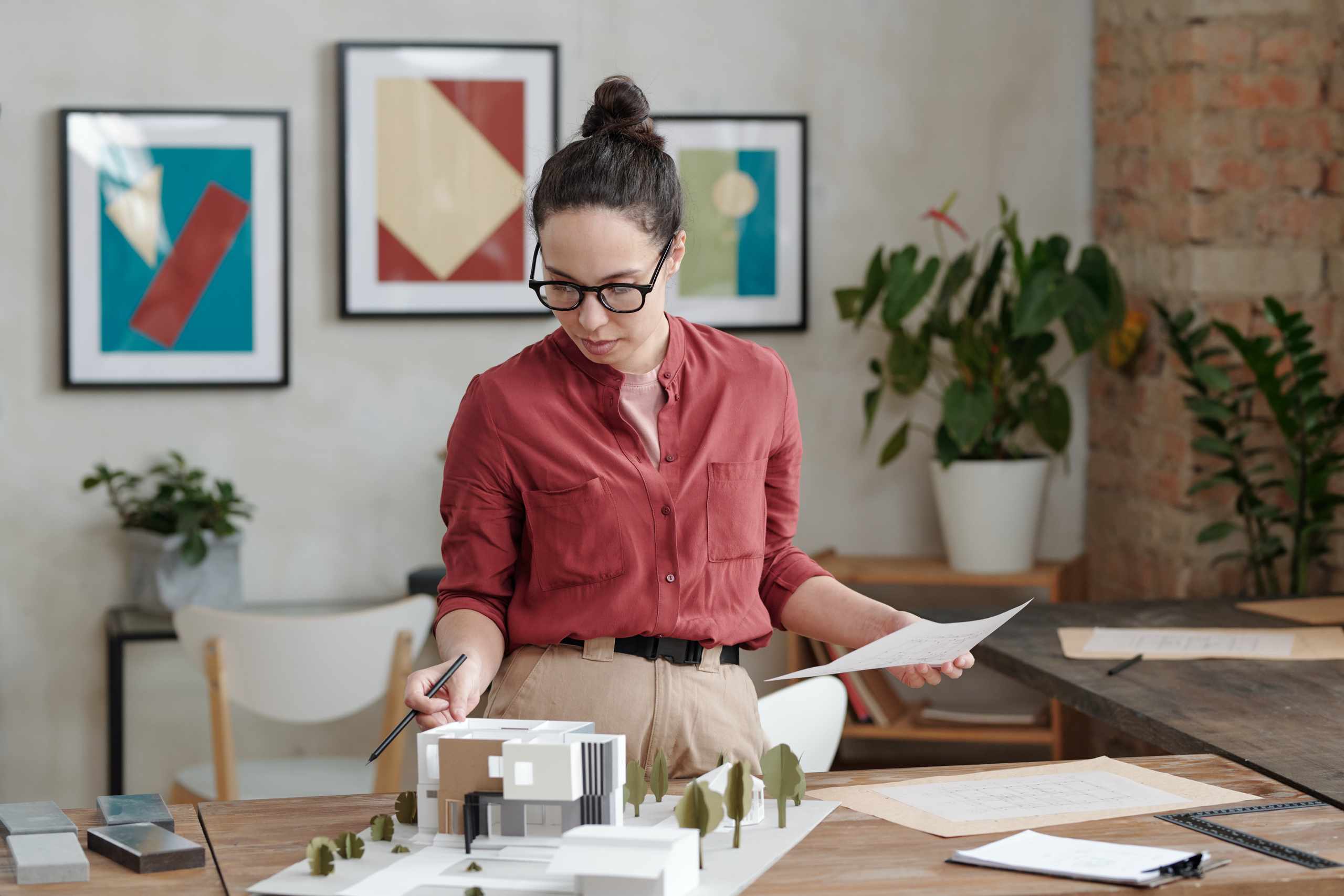
Before selecting a design concept, first select a room. This could be a bedroom, kitchen, corner of a study, small workspace, or any enclosed room where you can spend several minutes taking in its details without worrying about time. You are not judging whether the room looks good; instead, you are looking at how the different elements relate to one another: where the door is, where the light enters, how the window shapes how a room is furnished, and how a body moves from one area of the space to another.
The door is a good place to start. You control your first impression of a space from the doorway, so start by standing outside the room, in front of the door, and see what the door opens on to. Does it open to a plain wall, a void area, a piece of furniture? On entering, you should see whether you instinctively turn right, left, or straight ahead. This is just enough information to get an idea of how circulation might work. A plan starts making sense when you remember that every line on paper stands for a real action in space.
The next thing to observe is the window and the direction in which daylight falls. A window is more than just a hole in a wall; it sets a location where a person feels like sitting, it creates spots of glare in the day, it defines where it is possible to have a work station comfortably in it, it defines the livelier or quieter side of a room during daytime. If there are more than one, consider which window is stronger in terms of daylight, if any window gives better views, if one window feels less closed in than the other side of the space. Any of these observations could be noted down in your plans or sections.
Sketch the room. Just a pencil on any piece of paper. Draw the space in as a shape, and add the door and window and fixed furniture and maybe one or two key elements of furniture that you might have to move for people to move through a space. Keep some rough scale, and don’t forget clearances. You may also wish to note your path into the space as you draw your sketch, from the entrance to the main zone of the room. If a chair forces you to step around it, or a bed pushes you in another direction, or you avoid a cabinet door, show your circulation with an arrow.
This is a challenging part of the process: the temptation is to note the room’s qualities rather than its facts. We write, The room feels small, the room is cozy, the room looks busy, the room looks clean, the room looks simple. We can use words like those later, but now let’s just try to focus on the details in the space. The door opens in. The window is on the long wall. The work table is not facing daylight. The walk path is tighter next to the bed. There’s not enough clearance to pull back the chair. The list is much more likely to help us than a comment like the above.
You may now choose a second sheet of paper or tracing paper, and make a second attempt at the plan. This time, you may wish to organize the plan by thickness. Make the walls bold, the furniture light, the circulation arrow visible from a distance, and write some notes on the plan itself, such as: the direction of daylight, where the door opens, where clearance is too narrow, where the view is good. You’re not aiming to finish a poster; you’re trying to train your eye to be able to translate a plan, and see how this translates to a real space.
Your first observation exercise has now come to a close. The goal is now to look back at your sketch and to see if you can now point at where the space’s door is, what its relationship is to how one gets into the space, why daylight plays a role, how some of the elements of space furniture guide movement, and where there may be room to improve the space. This is a more valuable outcome than a beautiful-looking plan, at this moment. It’s now that the practice begins to work; rooms start to stop seeming as if they are made at random, and start to seem as if they can be read.